If we’ve learned anything working in sports, it’s that the limit of “I didn’t know that was a job,” “That job sounds so cool,” or “Where do I even start?” truly does not exist. It’s an incredibly fun industry to work in and around, but whether you’re on the outside looking in or even just the inside looking around, it can be a tough industry to crack in so many ways. There are many paths, many entry points, and many roles that don’t always look obvious from the outside.
That’s why Playmakers created our own framework for understanding “The Sports Industry”. What you’ll find below is not intended to be exhaustive; it’s designed to give you a place to start. A way to understand the landscape, a tool to help you ask better questions, a guide to help you identify what you care about, and a resource to help others help you.
One of the best parts of the Playmakers community is discovering all the different ways people can work in and around sports that you’ve never even considered. Whether it’s a full-time role, part-time work, or even volunteering to stay connected to the sports space, there are so many ways to be engaged. We hope this resource meets you wherever you are in your career and helps you take your next step with confidence.
We’ve approached mapping the sports industry by asking ourselves two simple but powerful questions: who can you work for and what can you do?
Think of “who can you work for,” as the employer side of the matrix – what part of the industry do you want to be in, based on who employs you.
Think of, ‘what can you do’, as the function, the day-to-day work, skills and responsibilities you would be doing.
You can utilize these two questions as individual explorations or look at the intersection of them! For example, perhaps you know you want to work for a team or a league, but you’re not sure what exactly you want to do (or you don’t care!). Then you can focus more on getting to know different functions at teams and leagues, building relationships with people in those organizations, and exploring the employer side. On the contrary, perhaps you’re already in marketing and want to make the jump into marketing within sports – then explore the ‘who you can work for’ side to understand what marketing looks like within different parts of the sports industry. Lastly, you might know that you want to do marketing for a team or a league – in that scenario, you’re narrowing in on the intersection of our two questions, and you should explore opportunities as such.
At the end of this resource, you’ll find both of our questions plotted into a downloadable grid that you can use as you explore careers in the sports industry, whether you know exactly where you want to go or are just starting out.
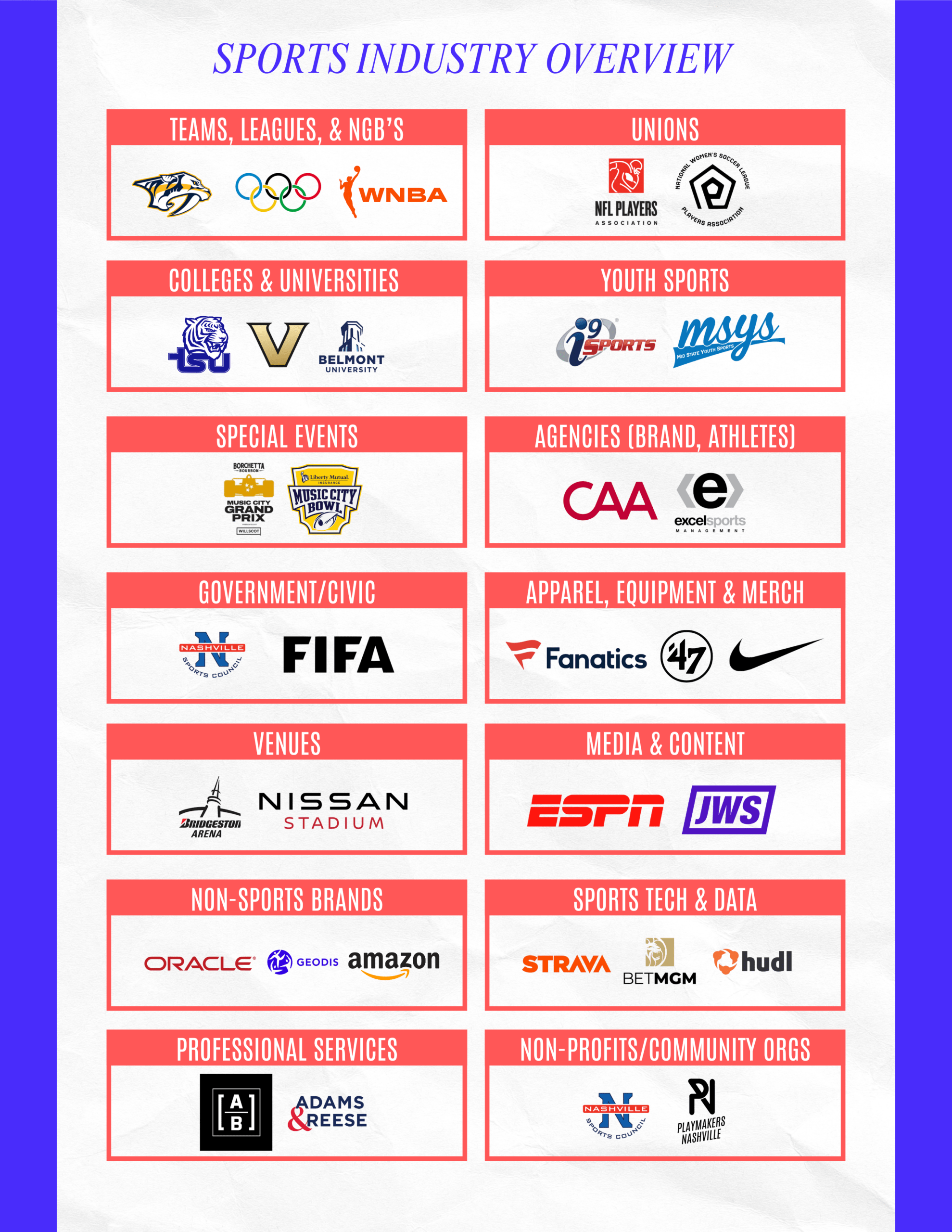
Click on image to view larger version.
Download: Who You Can Work For
● Professional / Semi-Professional Teams, Leagues, National Governing Bodies (NGBs) – These organizations are responsible for organizing and operating sports competitions across all levels. Teams and leagues typically manage domestic professional or semi-professional competition, while NGBs oversee Olympic and international sports. Examples of employers include: NFL, WNBA, Athletes Unlimited, Nashville Predators, Washington Spirit, USA Swimming, USOPC, etc.
● Unions – Sports unions, often referred to as Players Associations, are labor organizations that represent the collective interest of athletes. Unions collectively bargain with the athletes’ on-field employer (e.g., NFL, NWSL, etc) to establish standards for compensation, health and safety, competition integrity, and more. Many professional sports unions in North America, and an increasing number globally, also represent athletes’ collective commercial interests via group marketing and licensing. Examples of employers include: NFL Players Association (NFLPA), NWSL Players Association (NWSLPA), NHL Players Association (NHLPA), etc.
● Colleges & Universities – Colleges and Universities are responsible for fielding teams and competitions for sports at the collegiate level. Many collegiate sports programs have significant athletic departments that manage everything from on-field/court performance and operations to student-athlete development and growth. In the last several years, with the loosening of NIL restrictions, many collegiate programs also conduct commercial activities for athletes within their program or via a partner organization. Examples of employers include: Vanderbilt University, Ohio State University, The Big Ten Conference, Vanderbilt Enterprises, etc.
● Youth Sports – Youth sports organizations are responsible for fielding, organizing, and operating youth and amateur sports at both a local and national level. This can include leagues, teams, camps, showcases, tournaments, and more. Examples of employers include: local teams, leagues and clubs, The AAU, Little League World Series, etc
● Special Events (e.g., grassroots, NYC Marathon) – Special events organizations develop, organize, and operate special events locally, nationally, and globally. These events can range from individual marathons to global competitions such as the Olympics. They are unique from teams and leagues in that they do not operate continually, but instead are held at a certain interval, often annually, biannually, or quadrennially. Examples of special events include: Olympic Games, New York City Marathon, Tough Mudder Challenges, etc.
● Sports Agencies (brands, athletes)– Sports agencies are intermediaries that represent athletes, brands, teams/leagues, and more across a spectrum of topics. This can include, but is not limited to, representing athletes in contract negotiations and marketing opportunities, representing brands in terms of sponsorship and marketing activities, and representing teams and leagues for sponsorship sales, PR, and more. Agencies can be large and expansive, covering a multitude of use cases or small and specialized, focusing on a handful of clients or a specific expertise. Examples of employers include: CAA, Wasserman, Team Services, Excel Sports Management, etc.
● Government & Civic Organizations – Government and Civic organizations that impact sports include local organizing authorities, among others. These organizations are responsible for engaging the community on critical topics, bringing sports and events to a locale, and managing facilities and venues owned by cities and states. Example employers include Nashville Sports Council, Nashville Sports Authority, Bay Area Host Committee, etc.
● Sports Apparel, Equipment & Merchandise – This part of the industry is responsible for developing, producing, and distributing equipment, apparel, and other hard goods that are necessary to perform the sport. Additionally, many of these companies are also consumer-facing brands, selling goods and apparel to regular consumers for day-to-day use. Many of these brands also utilize athletes and teams/leagues for sponsorship and marketing purposes. Examples of employers include: Nike, New Balance, On Running, Rawlings, etc.
● Venues – This part of the industry refers to the physical structures, facilities, and locations that hold competitions, training, and other events and entertainment. Venues can include stadiums, arenas, racetracks, training complexes, and more. Sometimes these venues are independent, others are owned by sports teams and leagues, while others are owned by government entities. Examples of employers include: Bridgestone Arena, Nissan Stadium, Madison Square Garden, Municipal Auditorium, etc.
● Media and Content – Media and content companies develop, produce, and distribute sports-related content across platforms, including TV, print, audio, etc. Traditional media companies such as ESPN, acquire rights to broadcast games to their audience, while modern media companies, such as Jomboy Sports, are creator-first, developing content to distribute with a focus on sports. Example employers include: ESPN, Fox Sports, Just Women’s Sports, The Athletic, Wave Sports + Entertainment, etc
● Non-Sports Brands – Non-sports brands refer to brands that do not make a good or provide a service that is endemic to one or more sports, but engage in marketing and sponsorship activities via sports, whether it be athletes, facilities, teams, leagues, or more. Non-sports brands engaged in sports can range from small local companies advertising in a baseball stadium to global corporations partnering with athletes or naming stadiums. Examples of employers include: Rebel Girls, Insbank, Glossier, PepsiCo, Audi, etc.
● Sports Tech and Data (Sports Betting) – Sports tech and data includes the collection, analysis, and monetization of data from players, games, fans, and more. This can include wearables, data and analytics companies, sports betting organizations, and more. Example employers include: Whoop, Oura Ring, Fortress, FanDuel, etc.
● Professional Services (e.g., law, venture capital, private equity) – Professional services refer to expert, often knowledge based services provided with a topical focus on sports. This can include law, venture capital, private equity, consulting, and more.
● Non-profits & Community Organizations – These types of organizations operate within and around the sports industry for public-benefit, not private profit. These largely mission driven organizations can exist across sports and include membership organizations like Playmakers, professional sports team community foundations, and more. Example employers include: Tennessee Titans One Foundation, Playmakers Nashville, Play Like A Girl, etc.
● Other – We don’t claim to have been fully exhaustive in the above! Just know there’s a ton of other people you can work for and still be in or around sports. Examples include vendors who provide catering services to stadiums, sign makers, construction companies, and more.
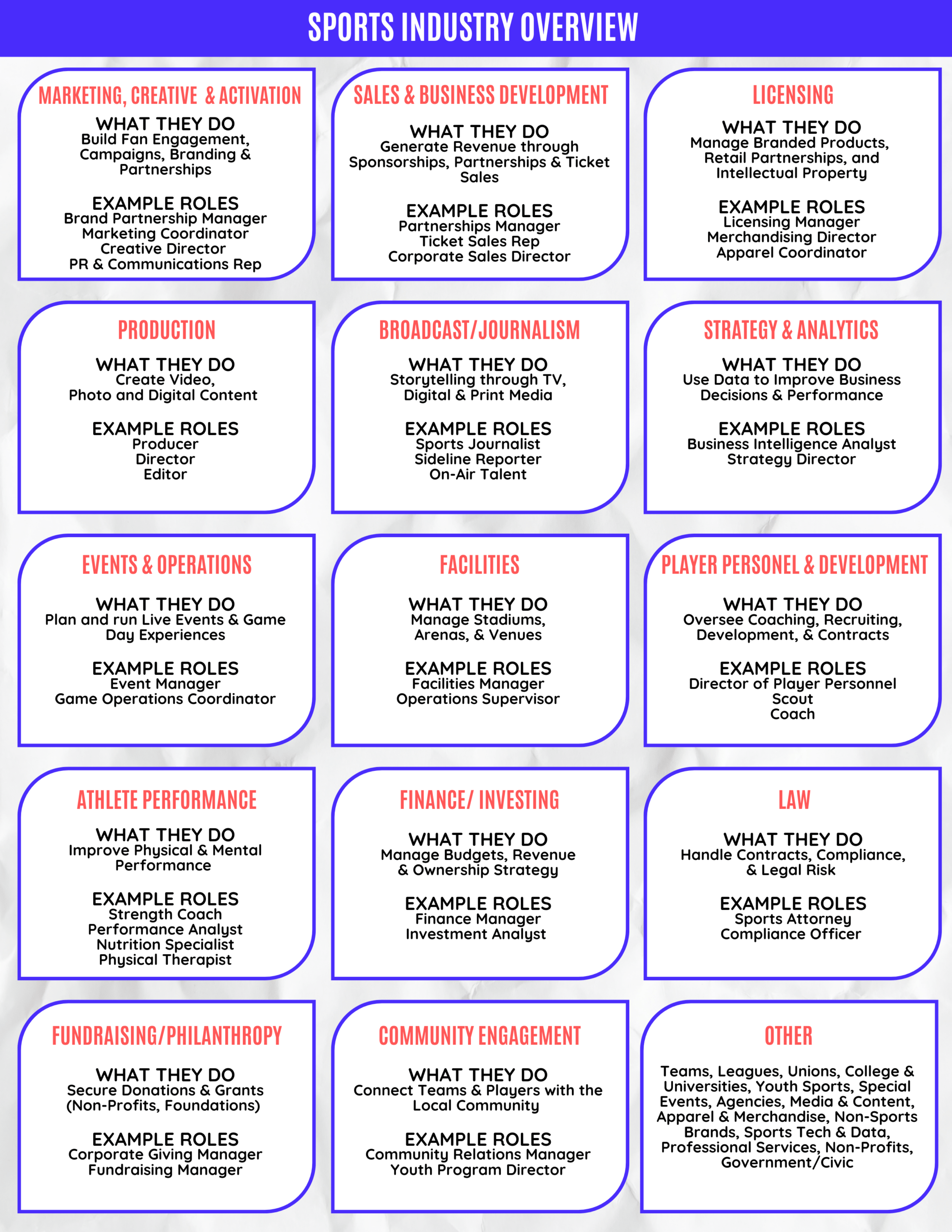
Click on image to view larger version.
Download: What You Can Do
● Marketing, Creative, & Activation blends branding, advertising, sponsorships, fan engagement, experiences, and communications that drive awareness and revenue. ● Sales & Business Development focuses on generating revenue via short- and long-term relationship development, lead identification, and closing deals across the sports industry. Examples include ticket sales, sponsorship sales, premium service sales, and more.
● Licensing involves granting rights to use intellectual property (IP) of teams, leagues, brands, athletes, and more on products and merchandise. Sports IP often includes team and league logos, athlete name image and likeness, and more.
● Production is the planning and execution of live events and media content, including live broadcasts, in-game presentations, social media content, branded content, and more. Production services can include a range of jobs including videography, project management, editing, producing, and more.
● Broadcast/ Journalism refers to reporting, analyzing, and sharing sports games, stories, news, and more to the public. This includes play-by-play commentary, investigative reporting, social media, and other forms of journalism across platforms such as print, live TV, social media, podcast, and more.
● Strategy & Analytics is the use of data and research to inform decision making, both on-the-field and off-the-field, in order to optimize outcomes. Examples of areas of focus include player development, game strategy, revenue optimization, financial investment, and more.
● Events & Operations roles involve the planning, organization, and execution of games and live events. Types of event and operations activities include scheduling, staffing, facilities coordination, fan services, security and day-of activation, and more.
● Facilities include roles focused on maintaining, operating, and improving venues, such as stadiums, arenas, training complexes, and more. Work in this area includes maintenance, safety, event readiness, playing surface management, and more.
● Player Personnel and Development (Coaching + GM + scouting) refers to the identification, development, and direction of athletes and teams. These roles are responsible for creating and executing the on-field/court vision and success for an organization.
● Athlete Performance (medical, nutrition, trainers, strength etc) includes all the roles responsible for ensuring an athlete is performing at his or her peak. This can include medical personnel, nutritionists, athletic trainers, strength and conditioning coaches, and more. These types of roles can be employed by teams, leagues, or athletes themselves.
● Athlete Representation often referred to as agents, advocate for and manages the professional and sometimes personal interests of athletes. Agents are responsible for negotiating contracts, identifying and securing endorsement opportunities, and managing other relevant aspects of an athlete’s life. Many agents are part of major agencies, though can also work independently.
● Finance/Investing includes the management of money, resources, and investments for teams, leagues, athletes, and other entities. Additionally, it can include the investment in sports and sports-related properties via venture capital, private equity, or other institutional capital.
● Law in sports includes a range of applications from contract negotiation and review, to IP protection, labor relations, compliance, regulatory and policy issues, and more. While some firms specialize in sports, many major law firms have partners or practices focused on sports. Additionally, most organizations within sports have some form of legal support, whether via in house departments or engagements with outside counsel.
● Fundraising/ Philanthropy refers to the teams and individuals focused on generating philanthropic support for an organization via donations, sponsorships, and partnerships. Some non-profit organizations in sports are funded largely via mission-aligned philanthropy, whereas others are mission-aligned offshoots of for-profit organizations.
● Community Engagement refers to roles focused on creating deep and meaningful connections between sports organizations and the communities in which they operate, for whom they represent. This can include creating programs, events, and initiatives that engage the relevant community and give back to it.
● Other – just like the “who you can work for section, we know this isn’t exhaustive! There are a ton of ways to work in and around sports! If you don’t see something that piques your interest here, start asking questions. We have no doubt there’s someone out there who can help guide you in the right direction.
While not comprehensive, this framework is designed to give you a clear starting point. Beyond understanding the structure of the industry, our biggest piece of advice is simple: get to know people. Sports is a relationship-driven industry, and learning from people across different employers and functions will help you find where you belong. No matter where you are in your journey, there is space for you in sports, and we’re glad you’re here
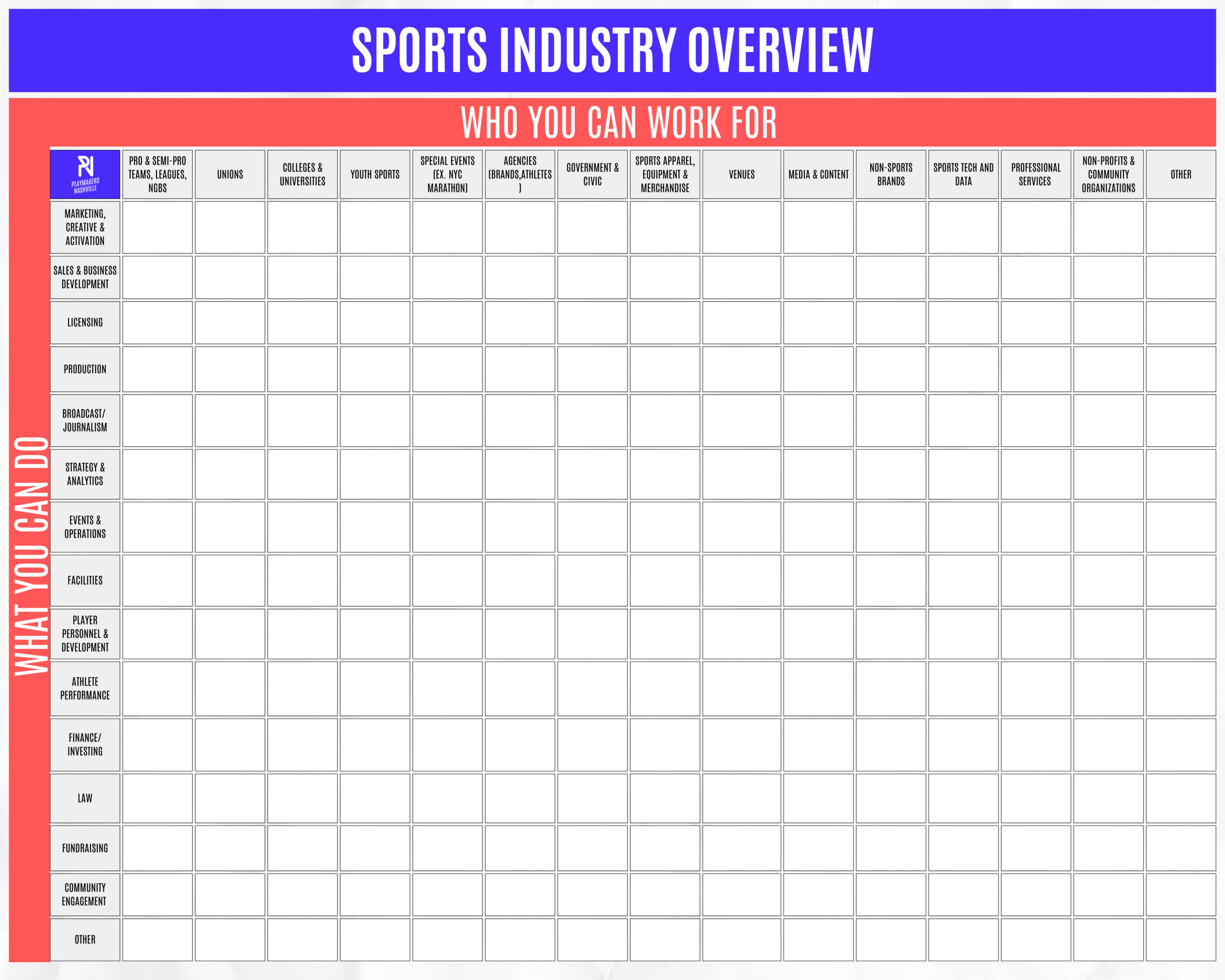
Click on image to view larger version.